
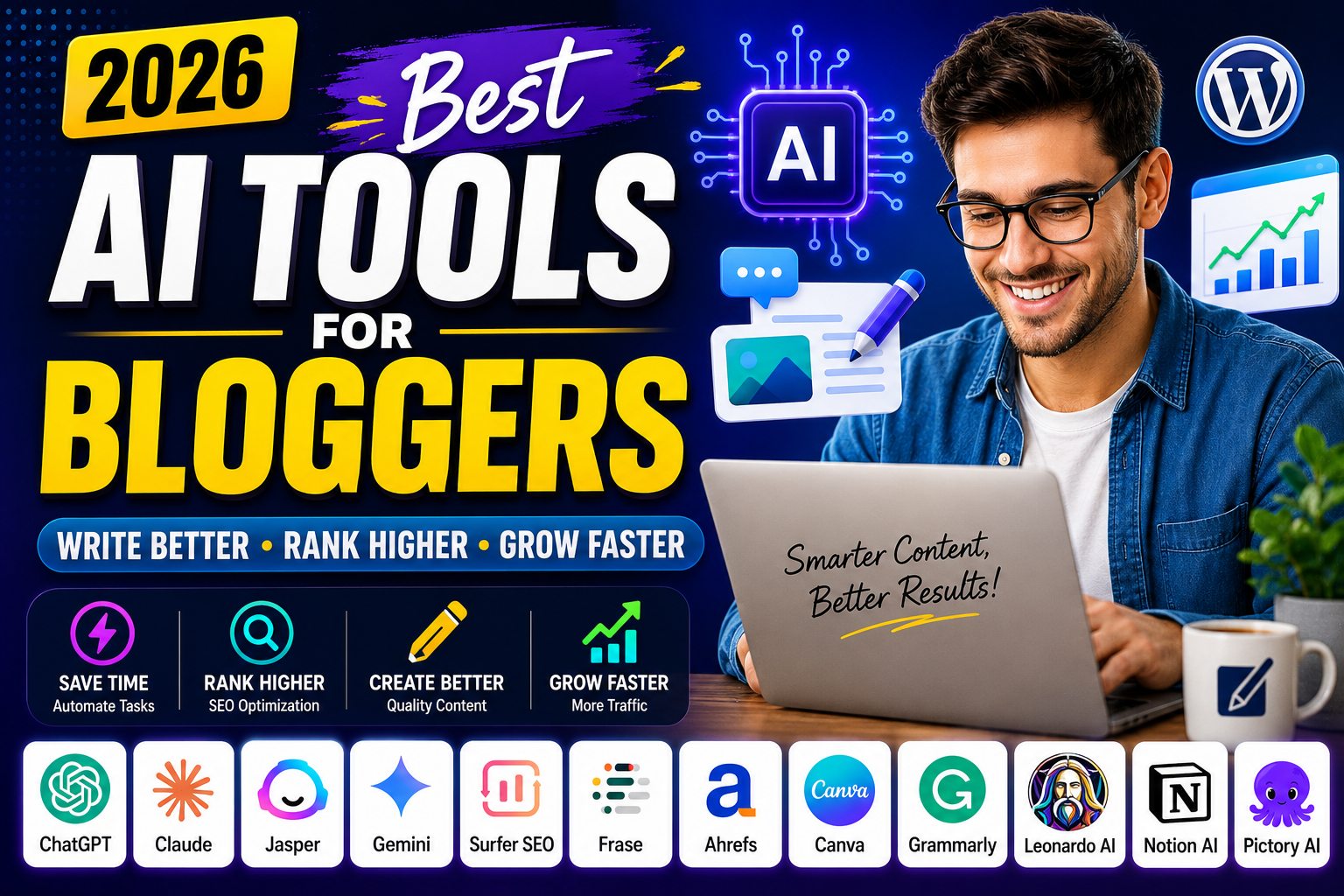

Best AI Tools for Bloggers in 2026: The Complete AI Blogging Toolkit
Blogging in 2026 is no longer just about writing articles faster.
Successful bloggers now need to research topics, understand search intent, create outlines, write useful content, optimize for search engines, create images, edit drafts, and promote content across multiple channels.
That is where AI tools for bloggers can make a major difference.
The best AI tools can help reduce repetitive work while giving bloggers more time to focus on strategy, expertise, originality, and audience needs.
However, choosing the right tools can be difficult.
There are now AI writing assistants, research platforms, SEO optimizers, image generators, grammar checkers, content planners, and AI-powered productivity tools competing for a place in a blogger's workflow.
So instead of simply listing dozens of AI products, this guide focuses on which tools are useful for each stage of blogging.
Quick Answer: What Are the Best AI Tools for Bloggers in 2026?
For most bloggers, a practical AI stack starts with a general-purpose AI assistant such as ChatGPT or Claude, combined with a dedicated SEO/content optimization tool such as Surfer SEO or Frase, an editing tool such as Grammarly, and an AI design platform such as Canva.
Current 2026 guides similarly emphasize combining several specialized tools rather than relying on one platform for every task.
| Category | Recommended Tool | Best For |
|---|---|---|
| Best Overall | ChatGPT | Ideas, research, outlines, drafting |
| Best for Long-Form Writing | Claude | Natural long-form drafts |
| Best for SEO | Surfer SEO | Content optimization |
| Best for SEO Research | Frase | Content briefs and optimization |
| Best for Research | Perplexity | Web research and source discovery |
| Best for Editing | Grammarly | Grammar, clarity and tone |
| Best for Images | Canva AI | Blog graphics and visual content |
| Best for Content Planning | Notion AI | Planning and organization |
| Best for Teams | Jasper | Brand-focused content workflows |
Our overall recommendation: don't build your blogging business around a single AI tool. Build a workflow where each tool solves a specific problem.
Best AI Tools for Bloggers
What Makes an AI Tool Good for Bloggers?
Not every AI tool marketed to content creators is actually useful for blogging.
A good blogging tool should help with one or more of these areas:
1. Content Research
The tool should help you understand:
- What people are searching for
- What questions readers ask
- Which topics deserve coverage
- What information needs verification
- Which sources should be investigated
2. Content Creation
A useful AI writing assistant should help with:
- Brainstorming
- Outlines
- Introductions
- Drafting
- Rewriting
- Expanding sections
- Summarizing
- Repurposing content
3. SEO Optimization
For SEO-focused bloggers, the tool should assist with:
- Search intent
- Keyword usage
- Topic coverage
- Headings
- Content structure
- Internal linking opportunities
- Content optimization
4. Editing
AI can also help identify:
- Grammar problems
- Awkward sentences
- Repetition
- Weak transitions
- Unclear wording
- Tone inconsistencies
5. Visual Content
Modern blogs also need:
- Featured images
- Article graphics
- Infographics
- Social media images
- Product illustrations
6. Productivity
Finally, AI can reduce the amount of time spent on:
- Content calendars
- Task management
- Content repurposing
- Social posts
- Email drafts
- Research organization
The important point is that AI should support the blogging process rather than replace the blogger.
1. ChatGPT — Best Overall AI Tool for Bloggers
Best for: brainstorming, research assistance, outlines, drafting, editing and content repurposing.
ChatGPT is one of the most versatile AI tools available to bloggers because it can be used across almost every stage of the content workflow.
Instead of using it only as an article writer, bloggers can use it as a content strategy assistant.
What Bloggers Can Use ChatGPT For
You can use ChatGPT to:
- Generate article ideas
- Create content clusters
- Build article outlines
- Analyze search intent
- Develop FAQs
- Rewrite sections
- Improve introductions
- Create meta descriptions
- Generate title variations
- Brainstorm internal links
- Repurpose articles into social posts
- Create email newsletter drafts
- Explain complicated subjects
- Review an existing article
For example, instead of asking:
"Write me a 2,000-word article about laptops."
A better workflow is:
Research the search intent → create the content structure → identify missing subtopics → draft sections → fact-check → edit → optimize.
This produces a much more controlled result.
Why ChatGPT Is Useful for Bloggers
Its biggest advantage is flexibility.
A blogger can move from research and brainstorming to writing, editing and content repurposing without constantly changing platforms.
However, AI-generated information still needs human review.
Specific claims, statistics, prices, product specifications and current information should be independently verified before publication.
Best For
Best overall AI assistant for bloggers who want one flexible tool.
2. Claude — Best for Long-Form Writing
Best for: long-form drafts, rewriting and maintaining a natural writing style.
Claude is another strong choice for bloggers who care about readability and long-form content.
Current 2026 comparisons commonly position Claude as a strong option for natural long-form writing, while ChatGPT is often favored for broader versatility.
Claude can be particularly useful when you already have:
- A detailed outline
- Brand guidelines
- Existing article sections
- A specific tone
- A large amount of reference material
Instead of asking AI to invent everything, give it the structure and context first.
Claude Is Useful For
- Long-form article drafts
- Rewriting
- Content expansion
- Summarization
- Tone adjustment
- Editing
- Brainstorming
One Important Limitation
Claude should not be treated as a substitute for original expertise.
A blog filled with generic AI-generated paragraphs may technically be readable but still offer little reason for someone to choose your website over hundreds of competitors.
The best workflow is:
AI draft → human expertise → fact-checking → original examples → final editing.
3. Surfer SEO — Best AI SEO Tool for Bloggers
Best for: on-page SEO and content optimization.
Writing a good article is only part of blogging.
You also need to understand whether the article adequately covers the topic and matches the search intent.
Surfer SEO is designed around content optimization and can help bloggers analyze and improve articles before publishing.
Typical workflows include:
- Creating content briefs
- Analyzing competing pages
- Identifying related terms
- Improving topical coverage
- Optimizing article structure
- Reviewing content scores
Current 2026 blogging guides continue to position Surfer as one of the leading options for SEO-focused content optimization.
Best For
Bloggers who already understand basic SEO and want a more structured optimization workflow.
For a site like GearChoiceLab, this type of tool can complement the existing Rank Math + Google Search Console workflow rather than replacing it.
4. Frase — Best for Content Briefs and SEO Research
Best for: content briefs, SERP research and SEO-focused writing.
Frase combines research and content optimization features, making it useful when you want to understand what should be included in an article before writing it.
It can help bloggers investigate:
- Search results
- Common topics
- Questions
- Content structures
- Related concepts
- Optimization opportunities
Some 2026 comparisons position Frase as a particularly strong all-around option for bloggers who want SEO research and writing capabilities together.
Best For
Bloggers who want to answer:
"What should my article cover before I start writing?"
That's different from simply asking an AI chatbot to generate an article.
5. Perplexity — Best for AI-Assisted Research
Best for: research, source discovery and fact-checking.
Research is one of the most useful applications of AI for bloggers.
Perplexity is designed around answering questions with web-based sources, making it useful during the research stage.
Bloggers can use it to investigate:
- Product specifications
- Industry developments
- Company information
- Current trends
- Technical concepts
- Supporting sources
Several current 2026 guides identify Perplexity as a strong research tool for bloggers.
Important Rule
Never assume that an AI-generated answer is automatically accurate.
Use AI to find and organize information, then verify important claims against authoritative sources.
For technology articles, that means prioritizing:
- Official manufacturer pages
- Official documentation
- Reputable testing publications
- Original research
- Reliable industry sources
The Best AI Blogging Workflow
The biggest mistake bloggers make is asking one AI tool to do everything.
A better approach is to create a workflow.
Step 1 — Find the Topic
Use:
ChatGPT + Google Search Console + keyword research
Find topics that have genuine audience demand.
Step 2 — Research
Use:
Perplexity + official sources
Collect facts, questions and supporting information.
Step 3 — Build the Outline
Use:
ChatGPT or Claude
Create the H2/H3 structure around search intent.
Step 4 — Create the Draft
Use:
ChatGPT or Claude
Generate a controlled first draft from your research and outline.
Step 5 — Optimize for SEO
Use:
Surfer SEO or Frase + Rank Math
Improve topical coverage, structure and on-page SEO.
Step 6 — Edit
Use:
Grammarly + human editing
Fix grammar, clarity and unnatural phrasing.
Step 7 — Create Visuals
Use:
Canva AI or another image-generation tool
Create the featured image and supporting graphics.
Step 8 — Fact-Check
Review:
- Prices
- Specifications
- Dates
- Statistics
- Product claims
- Links
Step 9 — Publish
Then monitor:
Google Search Console → impressions → clicks → CTR → queries → rankings
This final step is especially important for an SEO-driven blog.
6. Grammarly — Best AI Tool for Editing Blog Content
Best for: grammar, clarity, readability, and tone.
Even a well-researched article can lose credibility if it contains awkward sentences, grammar mistakes, or repetitive wording.
Grammarly is useful as a final editing layer before publishing.
Bloggers can use it to identify:
- Grammar mistakes
- Spelling errors
- Unclear sentences
- Repetitive wording
- Tone inconsistencies
- Readability problems
The most useful way to use Grammarly is after the article has already been written.
A practical workflow looks like this:
Research → Outline → Draft → Human editing → Grammarly → Final review → Publish
Don't blindly accept every suggestion. Sometimes an AI editing recommendation can change the meaning or tone of a sentence.
Best For
Bloggers who want a cleaner and more professional final draft.
7. Canva AI — Best AI Tool for Blog Images
Best for: featured images, blog graphics, social media visuals, and simple illustrations.
Visual content is an important part of modern blogging.
A strong featured image can make an article look more professional and improve its presentation when shared on social media or displayed in search-related surfaces.
Canva is particularly useful because bloggers can create:
- Featured images
- Pinterest graphics
- Facebook images
- Instagram posts
- Article illustrations
- Comparison graphics
- Simple infographics
- YouTube thumbnails
AI features can also speed up the creative process by helping generate concepts, layouts, and visual elements.
For a technology website like GearChoiceLab, you can use a consistent visual style across articles.
For example:
Laptop Reviews
Premium laptop + modern workspace + clean technology aesthetic.
AI Articles
Futuristic workspace + AI interface + digital elements.
Buying Guides
Multiple products + comparison layout + clear visual hierarchy.
This helps create stronger branding across the website.
Best For
Bloggers who need visual content but don't want to spend hours using professional design software.
8. Notion AI — Best for Content Planning
Best for: content calendars, organization, planning, and workflow management.
Writing articles is only one part of running a blog.
You also need to manage:
- Article ideas
- Keyword targets
- Publishing schedules
- Article status
- Content updates
- Internal linking
- Affiliate opportunities
- Performance tracking
Notion can be useful as a central content management workspace.
With AI features, bloggers can also:
- Summarize notes
- Generate ideas
- Create outlines
- Organize research
- Turn notes into drafts
- Create task lists
Example Content Workflow
You could organize your blog with columns such as:
| Article | Keyword | Status | Traffic Potential | Last Updated |
|---|---|---|---|---|
| Best AI Tools for Bloggers | Best AI Tools for Bloggers | Updating | High | 2026 |
| Dell XPS 13 Review | Dell XPS 13 Review | Published | Medium | 2026 |
| Best OLED Laptops | Best OLED Laptops | Updated | High | 2026 |
This makes it easier to identify which articles need:
- Updating
- Internal links
- Better titles
- More content
- New affiliate links
- Search Console analysis
Best For
Bloggers managing a growing content library.
9. Jasper — Best for Brand-Focused Content
Best for: teams, brand voice, marketing content, and content workflows.
Jasper is more focused on structured content creation and marketing workflows than a simple AI chatbot.
It can be useful for bloggers or content teams that want to maintain consistency across:
- Blog posts
- Email newsletters
- Social media
- Product descriptions
- Marketing content
One of the biggest challenges with AI-generated content is maintaining a consistent voice.
If multiple writers or AI tools are involved, the tone of your website can become inconsistent.
A brand-focused workflow can help solve that problem.
Best For
Professional bloggers, content teams, and websites producing content at scale.
For a solo blogger, however, a combination of ChatGPT or Claude plus a clear writing guideline may be sufficient.
10. Best Free AI Tools for Bloggers
You don't need to spend hundreds of dollars per month to start using AI.
In fact, new bloggers should avoid subscribing to too many tools immediately.
Start with a simple stack.
Recommended Free or Low-Cost AI Blogging Stack
For Ideas and Outlines
ChatGPT
Use it for:
- Topic ideas
- Article structures
- FAQ ideas
- Content clusters
- Headline variations
For Research
Perplexity
Useful for:
- Finding sources
- Understanding new topics
- Discovering related questions
For Editing
Grammarly
The free version can already help identify many common writing mistakes.
For Visual Content
Canva
Useful for creating blog thumbnails and social media graphics.
For SEO
Your existing SEO plugin, such as Rank Math, can help manage basic on-page optimization inside WordPress.
The important point is that beginners should not assume:
More tools = better content.
A blogger with five well-used tools can often outperform someone paying for fifteen tools without a clear workflow.
Best AI Tools for Affiliate Bloggers
Affiliate bloggers have slightly different requirements.
They don't just need to write articles.
They also need to create content that helps readers make purchasing decisions.
That means AI can be particularly useful for:
- Product comparisons
- Buying guides
- Feature comparisons
- FAQ generation
- Pros and cons
- Product research organization
- Table creation
- Content updates
However, this is where fact-checking becomes extremely important.
Never allow AI to invent:
- Product specifications
- Prices
- Battery life
- Compatibility information
- Product availability
- Testing results
For affiliate content, inaccurate information can damage both trust and conversion rates.
Recommended Affiliate Blogging Stack
Research: Perplexity + official product sources
Planning: ChatGPT or Claude
Writing: ChatGPT or Claude
SEO: Surfer SEO or Frase
Editing: Grammarly
Visuals: Canva
For GearChoiceLab, this workflow is particularly relevant because many of your articles are focused on:
- Laptop reviews
- Buying guides
- Technology products
- Productivity tools
- AI software
Best AI Tools for WordPress Bloggers
WordPress bloggers have an additional advantage because AI can support the workflow before content even reaches the WordPress editor.
A practical workflow could look like this:
Step 1: Research the Topic
Use:
Perplexity + official sources
Step 2: Analyze the Search Intent
Use:
ChatGPT or Claude
Identify whether users want:
- Information
- Product recommendations
- Comparisons
- Reviews
- Tutorials
Step 3: Create the Outline
Build:
- H1
- Introduction
- H2 sections
- H3 subsections
- FAQ
- Conclusion
Step 4: Write and Improve
Create the article in sections.
This is usually better than generating an entire article in one prompt.
Step 5: Move Into WordPress
Then use your WordPress editor to:
- Format headings
- Add images
- Add internal links
- Add affiliate links where appropriate
- Add tables
- Optimize metadata
Step 6: Optimize With Rank Math
Check:
- Focus keyword
- SEO title
- Meta description
- URL
- Headings
- Internal links
- External links
- Image alt text
Step 7: Publish and Monitor
Use Google Search Console to monitor:
- Impressions
- Clicks
- CTR
- Search queries
- Ranking changes
This workflow is much more effective than simply generating an article and immediately pressing Publish.
AI Tools for Content Repurposing
One blog article can become multiple pieces of content.
This is where AI can save bloggers a significant amount of time.
For example, imagine you publish:
Best AI Tools for Bloggers in 2026
You can use AI to transform that article into:
- A Twitter/X thread
- LinkedIn posts
- Facebook posts
- Instagram carousel ideas
- Pinterest descriptions
- Email newsletters
- Short video scripts
- FAQ content
Example Workflow
1 Blog Article
↓
5 Social Media Posts
↓
1 Email Newsletter
↓
3 Short Video Scripts
↓
Pinterest Pins
This allows you to get more value from each article you publish.
The key is to adapt the content to each platform rather than copying the exact same article everywhere.
Free vs Paid AI Tools for Bloggers
Should bloggers pay for AI tools?
The answer depends on how much content you create.
Free Tools Are Enough If You:
- Are just starting
- Publish a small number of articles
- Have a limited budget
- Need help with brainstorming
- Need basic editing
- Are still building traffic
Paid Tools Make Sense If You:
- Publish regularly
- Manage multiple websites
- Need advanced SEO research
- Create large amounts of content
- Work with a team
- Spend significant time researching and editing
A paid AI tool should ideally do one of two things:
Save you significant time or help produce significantly better results.
If it doesn't do either, you probably don't need the subscription.
The Best AI Blogging Stack by Budget
🟢 Budget Stack
Ideal for beginners.
- ChatGPT
- Perplexity
- Grammarly
- Canva
- Rank Math
Best for: bloggers starting a new website.
🔵 Growth Stack
Ideal for bloggers publishing consistently.
- ChatGPT or Claude
- Perplexity
- Surfer SEO or Frase
- Grammarly
- Canva
- Rank Math
Best for: bloggers focused on organic traffic growth.
🟣 Professional Stack
Ideal for serious publishers.
- ChatGPT
- Claude
- Perplexity
- Surfer SEO
- Grammarly
- Canva
- Notion AI
- Additional analytics and keyword research tools
Best for: larger content operations.
However, you should only add tools when they solve a specific problem.
There is no reason to pay for three AI writers if you primarily use only one.
A Better AI Workflow for Creating Blog Posts
Here is a practical process that bloggers can follow.
Step 1: Start With Search Intent
Before writing anything, ask:
What does the searcher actually want?
For example, someone searching:
"Best AI tools for bloggers"
probably wants:
- Tool recommendations
- Pricing information
- Features
- Comparisons
- Free options
- Recommendations based on different needs
They probably don't want a 1,000-word history of artificial intelligence.
Understanding this helps prevent unnecessary content.
Best AI Tools for Bloggers
Step 2: Build a Content Brief
Use AI to identify:
- Primary keyword
- Secondary keywords
- Reader questions
- Important subtopics
- Potential comparisons
- Internal linking opportunities
Then manually review the structure.
Best AI Tools for Bloggers
Step 3: Research Before Writing
Collect information from reliable sources.
For product or software reviews, prioritize:
- Official websites
- Documentation
- Product pages
- Independent testing
- Reputable reviews
AI should help organize the research—not replace it.
Best AI Tools for Bloggers
Step 4: Write the First Draft
Use your research and outline to create a structured draft.
Work section by section.
This gives you more control over:
- Accuracy
- Tone
- Structure
- Repetition
- Depth
Step 5: Add Original Value
This is the most important step.
Ask:
Why should someone read this article instead of another AI-generated article?
Add:
- Your analysis
- Practical recommendations
- Unique comparisons
- Personal testing when available
- Clear decision-making advice
- Real examples
Step 6: Edit Before Publishing
Finally:
- Check facts
- Remove repetitive sentences
- Improve transitions
- Check grammar
- Add internal links
- Add external sources
- Optimize images
- Review SEO metadata
Then publish.
Best AI Tools for Bloggers
Best AI Tools for SEO Bloggers
SEO blogging requires much more than inserting a keyword into an article.
A successful SEO workflow involves understanding search intent, covering the topic comprehensively, creating useful content, optimizing internal links, and monitoring performance after publication.
AI can assist with many of these tasks.
A practical SEO workflow looks like this:
Keyword research → Search intent → Content brief → Writing → Optimization → Internal linking → Publishing → Performance analysis
Tools such as Surfer SEO, Frase, ChatGPT, Claude, and Perplexity can each contribute to different stages of this process.
However, AI SEO tools should be treated as assistants rather than automatic ranking systems.
No tool can guarantee a Google ranking.
Best AI Tools for Bloggers
Best AI Tools for Keyword Research
Keyword research is one of the most important parts of blogging.
AI can help generate keyword ideas and identify related topics, but dedicated SEO platforms are generally better when you need detailed search-volume, competition, and ranking data.
AI tools are useful for:
- Generating keyword variations
- Finding long-tail keywords
- Identifying related questions
- Creating topic clusters
- Discovering content gaps
- Grouping keywords by search intent
For example, instead of targeting only:
"best laptops"
AI can help expand the topic into:
- best laptops under $1,000
- best laptops for programming
- best lightweight laptops
- best OLED laptops
- best laptops for students
- best laptops for remote work
This creates a topic cluster rather than a single isolated article.
For GearChoiceLab, this approach is particularly useful because the website already has multiple related laptop buying guides and reviews.
Best AI Tools for Bloggers
Best AI Tools for Writing Product Reviews
AI can be particularly useful when creating product review structures.
For example, a laptop review might include:
- Overview
- Specifications
- Design
- Display
- Performance
- Battery life
- Keyboard
- Touchpad
- Webcam
- Speakers
- Ports
- Gaming
- Programming
- Pros and cons
- Alternatives
- Final verdict
- FAQ
AI can help create the framework, but the facts must come from reliable sources or genuine testing.
This is especially important for affiliate content.
Don't allow AI to invent benchmark results or claim that you personally tested a product if you didn't.
A better workflow is:
Official specifications → independent reviews/testing → AI-assisted organization → human analysis → final article
This creates much more trustworthy content.
Best AI Tools for Bloggers
Best AI Tools for Affiliate Bloggers
Affiliate bloggers need to do more than generate traffic.
The content must help readers make a decision.
For example:
Which laptop should I buy?
is a different search intent from:
What is a laptop?
That's why AI can be useful for creating decision-oriented content.
AI can help you build:
- Product comparison tables
- Buying guides
- Pros and cons
- "Best for" recommendations
- Alternative product sections
- Feature comparisons
- FAQs
- Buyer personas
Example
Instead of writing:
The Dell XPS 14 has a high-resolution display.
A more useful affiliate-oriented section would explain:
The OLED configuration makes the XPS 14 particularly attractive for users who prioritize image quality, video consumption, photo editing, and a premium visual experience. However, buyers who prioritize maximum battery life may prefer the lower-resolution display configuration.
The second approach helps readers make a decision.
That's the difference between describing a product and helping someone choose a product.
Best AI Tools for Bloggers
Best AI Tools for Bloggers Who Write Product Comparisons
Comparison articles can be especially valuable for affiliate websites.
Examples include:
- Dell XPS 13 vs XPS 14
- OLED vs IPS laptops
- MacBook vs Windows laptop
- ChatGPT vs Claude
- Surfer SEO vs Frase
- 2.0 vs 2.1 computer speakers
AI can help organize the comparison into consistent categories.
Recommended Comparison Structure
| Category | Product A | Product B |
|---|---|---|
| Price | — | — |
| Performance | — | — |
| Display | — | — |
| Battery | — | — |
| Portability | — | — |
| Features | — | — |
| Best For | — | — |
Then finish with:
Choose Product A If...
and
Choose Product B If...
This makes the article much more useful than simply listing specifications.
Best AI Tools for Bloggers
AI Tools for Updating Old Blog Posts
This is one of the most valuable applications of AI for established websites.
You don't always need to create a new article.
Sometimes an older article already has:
- Google impressions
- Search queries
- backlinks
- historical rankings
- existing internal links
Instead of starting from zero, AI can help identify opportunities to improve the existing page.
A Useful Update Workflow
Step 1: Export or review Google Search Console data.
Look for:
- High-impression queries
- Low-CTR queries
- Queries where the article is ranking but not getting clicks
Step 2: Compare the existing article with those queries.
Step 3: Identify missing sections.
Step 4: Expand or rewrite the relevant sections.
Step 5: Improve the title and meta description.
Step 6: Add internal links.
Step 7: Add FAQs.
Step 8: Update outdated information.
Step 9: Request indexing after the changes.
This is often more efficient than continuously publishing new pages.
Best AI Tools for Bloggers
AI Tools for Internal Linking
Internal links help readers discover related content and can also help search engines understand relationships between pages.
AI can help identify potential connections between articles.
For example, a laptop review could link to:
- Best Laptops for Programming
- Best OLED Laptops
- Best Lightweight Laptops
- Best Laptops Under $1,000
- Best External SSDs
- Best Computer Speakers
But internal linking should be natural.
Don't add dozens of links simply because an AI tool suggests them.
A good internal link should answer:
Would this link genuinely help the reader?
If the answer is yes, add it.
Best AI Tools for Bloggers
AI Tools for Content Clusters
One of the strongest uses of AI for SEO is building topical clusters.
Instead of thinking:
"What article should I write next?"
Think:
"What group of articles should my website become an authority on?"
For example, a laptop cluster could look like this:
Pillar Topic
Best Laptops
↓
Supporting Topics
- Best Laptops Under $1,000
- Best OLED Laptops
- Best Laptops for Programming
- Best Lightweight Laptops
- Best Video Editing Laptops
- Best Laptops for Students
↓
Individual Reviews
- Dell XPS 13 Review
- Dell XPS 14 Review
- Lenovo Yoga 9i Review
- MacBook Air M4 Review
- Acer Swift Go Review
- Framework Laptop Review
This structure creates logical relationships between pages.
AI can help generate the initial map, but the final structure should be based on actual search demand and the website's expertise.
Best AI Tools for Bloggers
Best AI Tools for Content Refreshes
AI is particularly useful when an article is already ranking but has become outdated.
This can happen with:
- Technology products
- AI software
- Laptop specifications
- Prices
- Features
- Software versions
- Industry trends
A content refresh should not simply mean changing:
2025 → 2026
That's not a meaningful update.
Instead, review:
- Current products
- Current specifications
- Current pricing
- New competitors
- New search intent
- New FAQs
- New alternatives
- Outdated claims
- Internal links
Then rewrite sections that genuinely need improvement.
Best AI Tools for Bloggers
How to Use AI Without Hurting Content Quality
AI itself isn't the problem.
Low-value content is the problem.
Google's Search guidance focuses on whether content is helpful and created for people, while its spam policies warn against scaled content abuse—particularly when automation is used to generate large amounts of pages without adding real value.
That means bloggers should avoid this workflow:
AI → Generate 100 articles → Publish everything
Instead, use:
Research → AI assistance → Human expertise → Fact-check → Edit → Improve → Publish
The second workflow takes longer, but it creates a much stronger website.
Best AI Tools for Bloggers
7 Common Mistakes Bloggers Make With AI
1. Publishing AI Output Without Editing
An AI-generated draft is not automatically a finished article.
It can contain:
- Repetition
- Generic statements
- Incorrect facts
- Outdated information
- Awkward wording
Always review it.
Best AI Tools for Bloggers
2. Using the Same AI Structure for Every Article
If every article follows:
Introduction → 10 tools → Conclusion
your website can become repetitive.
Instead, adapt the structure to search intent.
A product review should look different from a tutorial.
A comparison should look different from a buying guide.
Best AI Tools for Bloggers
3. Overusing Keywords
AI can easily repeat a target keyword too many times.
Don't write for keyword density.
Write naturally around the topic.
For example, you don't need to repeatedly write:
best AI tools for bloggers
in every paragraph.
Use natural variations such as:
- AI tools for content creators
- AI blogging software
- AI writing assistants
- blogging automation tools
- AI-powered content tools
4. Trusting AI Facts Without Verification
This is particularly dangerous for technology websites.
AI can produce plausible but incorrect information.
Always verify:
- Prices
- Product specifications
- Battery claims
- Benchmark numbers
- Compatibility
- Software features
- Release dates
5. Writing Generic Content
One of the biggest weaknesses of AI-generated articles is generic advice.
For example:
"AI can save bloggers time and improve productivity."
That's true, but it doesn't provide much value.
A better article explains:
How?
For which task?
With which tool?
What are the limitations?
When should you use it?
That's where useful content begins.
Best AI Tools for Bloggers
6. Using Too Many AI Tools
You don't need ten AI subscriptions.
A simple stack can be enough.
For example:
ChatGPT + Perplexity + Rank Math + Canva
can already support a large portion of a solo blogger's workflow.
Add specialized tools only when you encounter a specific limitation.
Best AI Tools for Bloggers
7. Forgetting the Human Perspective
AI can summarize information.
But your website needs a reason to exist.
Add:
- Analysis
- Opinions
- Comparisons
- Practical recommendations
- Unique examples
- Experience
- Original research
That's what separates a useful website from an AI content farm.
Best AI Tools for Bloggers
AI Content and Google Search
This deserves special attention for bloggers.
Using AI to assist with content creation does not automatically mean a page cannot perform in Google Search.
The important question is whether the resulting content provides value.
Google's guidance emphasizes helpful, reliable, people-first content and warns against producing content at scale primarily to manipulate search rankings.
Therefore, a good AI-assisted article should answer:
Does it help the reader?
Is the information accurate?
Is the content original?
Does it provide meaningful analysis?
Does it satisfy the search intent?
Is it better than a generic AI-generated answer?
If the answer is yes, AI can be a valuable part of the workflow.
Best AI Tools for Bloggers
Which AI Tool Should Bloggers Choose?
The answer depends on what you're trying to accomplish.
| Blogger Type | Best Starting Tool |
|---|---|
| Beginner Blogger | ChatGPT |
| SEO Blogger | Surfer SEO |
| Research-Heavy Blogger | Perplexity |
| Long-Form Writer | Claude |
| Editing-Focused Blogger | Grammarly |
| Visual Blogger | Canva |
| Content Planner | Notion AI |
| Affiliate Blogger | ChatGPT + Perplexity |
| Professional Content Team | Jasper |
| WordPress Blogger | ChatGPT + Rank Math + Canva |
You don't need to purchase every tool in this table.
Instead, choose the tool that solves your biggest bottleneck.
Best AI Tools for Bloggers
Best AI Tool by Blogging Task
Here's the simpler version:
💡 Need Article Ideas?
ChatGPT
🔎 Need Research?
Perplexity
✍️ Need Long-Form Drafts?
Claude or ChatGPT
📊 Need SEO Optimization?
Surfer SEO
📝 Need Content Briefs?
Frase
✅ Need Grammar Editing?
Grammarly
🎨 Need Blog Images?
Canva
📅 Need Content Organization?
Notion AI
💰 Need Affiliate Content?
ChatGPT + Perplexity + official product sources
Best AI Tools for Bloggers
The Ideal AI Blogging Workflow in 2026
If you're starting or rebuilding an AI-assisted blogging workflow, keep it simple.
Research
Perplexity + Google + official sources
↓
Strategy
ChatGPT
↓
Outline
ChatGPT or Claude
↓
Draft
ChatGPT or Claude
↓
SEO
Surfer SEO / Frase + Rank Math
↓
Editing
Grammarly + human review
↓
Visuals
Canva
↓
WordPress
Format + internal links + affiliate links
↓
Google Search Console
Monitor impressions + clicks + CTR + queries
↓
Content Update
Use performance data to improve the article
This final stage creates a continuous content improvement cycle.
Best AI Tools for Bloggers
The Best AI Stack for GearChoiceLab
For a technology affiliate website like GearChoiceLab, I would keep the workflow relatively simple.
Research
Perplexity + official manufacturer/product sources
Content Strategy
ChatGPT
Article Drafting
ChatGPT
SEO
Rank Math + Google Search Console
Editing
Grammarly
Images
Canva / AI image generation
Performance Monitoring
Google Search Console
Content Optimization
ChatGPT + Search Console data
This approach avoids unnecessary subscriptions while still giving you a powerful AI-assisted publishing workflow.
Best AI Tools for Bloggers
Best AI Tools for Bloggers: Comparison Table
Choosing an AI tool becomes much easier when you compare each platform according to its primary purpose.
| AI Tool | Best For | Main Strength | Ideal User |
|---|---|---|---|
| ChatGPT | Overall blogging | Versatility | Most bloggers |
| Claude | Long-form content | Natural writing | Writers |
| Perplexity | Research | Source discovery | Research-heavy bloggers |
| Surfer SEO | SEO optimization | Content optimization | SEO bloggers |
| Frase | Content briefs | SERP/content research | SEO writers |
| Grammarly | Editing | Grammar and clarity | All bloggers |
| Canva | Visual content | Blog graphics | Content creators |
| Notion AI | Organization | Content planning | Solo bloggers & teams |
| Jasper | Marketing content | Brand workflows | Businesses & teams |
The important thing is that these tools are not direct substitutes for one another.
For example, a research tool and an editing tool solve completely different problems.
Best AI Tools for Bloggers
Best AI Tools for Bloggers by Budget
You don't need an expensive AI stack to start a successful blog.
Your budget should grow only when your content operation grows.
Best Free AI Blogging Stack
For beginners, start with:
- ChatGPT
- Perplexity
- Grammarly
- Canva
- Rank Math
- Google Search Console
This combination can cover a surprisingly large portion of the blogging workflow.
Best For
New bloggers with limited budgets.
Best AI Tools for Bloggers
Best AI Stack Under $50 Per Month
If you're ready to invest in your website, focus on tools that provide measurable value.
A practical combination could include:
One general-purpose AI assistant + one SEO/content tool + one visual/editing tool.
For example:
ChatGPT or Claude + an SEO platform + Canva/Grammarly
The exact subscription cost depends on the plans you select, so check the current pricing before subscribing.
Best For
Bloggers who publish regularly and want to improve efficiency without building an expensive technology stack.
Best AI Tools for Bloggers
Best AI Stack for Professional Bloggers
Professional bloggers can justify additional tools when they are managing:
- Multiple websites
- Large content libraries
- Multiple writers
- Affiliate campaigns
- Large publishing schedules
- Social media distribution
A professional workflow might include:
ChatGPT
Claude
Perplexity
Surfer SEO or Frase
Grammarly
Canva
Notion
But there's an important rule:
Don't pay for two tools that perform the same job unless they provide a meaningful advantage.
Best AI Tools for Bloggers
Best AI Tools for Different Types of Bloggers
Best AI Tools for Beginner Bloggers
Start with:
ChatGPT + Canva + Grammarly
This gives you the basic tools for:
- Ideas
- Outlines
- Drafting
- Editing
- Visual content
You can add dedicated SEO software later.
Best AI Tools for Bloggers
Best AI Tools for SEO Bloggers
Recommended stack:
ChatGPT + Perplexity + Surfer SEO + Rank Math
This covers:
- Research
- Search intent
- Content planning
- Writing
- SEO optimization
- WordPress implementation
Best AI Tools for Affiliate Bloggers
Recommended stack:
Perplexity + ChatGPT + Rank Math + Canva
Use Perplexity for research and source discovery, ChatGPT for organization and content development, Rank Math for on-page SEO, and Canva for visual assets.
But remember:
Never let AI invent product specifications or testing results.
Affiliate content depends heavily on trust.
Best AI Tools for Bloggers
Best AI Tools for Technology Bloggers
Technology bloggers often need to work with rapidly changing information.
A strong workflow is:
Perplexity → Official sources → ChatGPT → Grammarly → Rank Math
Use official manufacturer pages for specifications and independent testing for performance claims.
This is especially important for:
- Laptop reviews
- Smartphone reviews
- AI software reviews
- Hardware comparisons
- Product buying guides
Best AI Tools for Solo Bloggers
A solo blogger doesn't need a complicated content operation.
A simple stack can be enough:
ChatGPT + Perplexity + Rank Math + Canva
This keeps costs and complexity under control.
Best AI Tools for Bloggers
Best AI Tools for Content Updates
One of the most underrated AI use cases is updating existing articles.
Suppose an article already has:
5,000 impressions but only 20 clicks.
That page already has evidence of search visibility.
Instead of immediately creating another article, analyze:
- Search queries
- CTR
- Average position
- Missing topics
- Search intent
- Outdated information
- Title quality
- Meta description
Then use AI to help improve the page.
Example
If Search Console shows that an article receives impressions for:
best OLED laptop for programming
but the article barely discusses programming, you have an obvious content gap.
Add a dedicated section:
Best OLED Laptops for Programming
Then explain:
- Display benefits
- Text clarity
- RAM requirements
- CPU requirements
- Battery considerations
- Potential OLED drawbacks
That's a much better use of AI than simply generating another 2,000-word article.
Best AI Tools for Bloggers
How AI Can Help Improve CTR
AI can also help brainstorm better titles and meta descriptions.
For example:
Generic
Best AI Tools for Bloggers
More compelling
Best AI Tools for Bloggers in 2026: 10 Tools Worth Using
Search-intent focused
Best AI Tools for Bloggers in 2026: Writing, SEO, Research & More
The third title communicates exactly what the reader will find.
However, avoid clickbait.
A title should accurately represent the content.
Best AI Tools for Bloggers
How AI Can Help With Featured Snippets and FAQs
AI can help identify common questions surrounding a topic.
For this article, useful questions include:
- What is the best AI tool for bloggers?
- Which AI is best for writing blog posts?
- What is the best free AI tool for blogging?
- Can AI write SEO-friendly blog posts?
- Is AI-generated content allowed by Google?
- Can bloggers use ChatGPT for affiliate content?
- What AI tools help with keyword research?
- What is the best AI tool for SEO?
These questions can become FAQ sections when they genuinely help readers.
Don't add FAQs simply to insert more keywords.
Best AI Tools for Bloggers
Should Bloggers Use AI to Write Entire Articles?
Technically, AI can generate an entire article.
But that doesn't mean you should publish the output without significant human involvement.
A better process is:
AI
Research assistance
↓
Ideas
↓
Outline
↓
Draft assistance
Human
Expertise
↓
Fact-checking
↓
Original analysis
↓
Editing
↓
Final approval
This produces a much stronger article.
Google's guidance emphasizes people-first content and warns against using automation primarily to manipulate search rankings.
Therefore, don't measure your AI workflow by:
"How many articles can I publish today?"
Measure it by:
"How much better and more efficiently can I make each useful article?"
Best AI Tools for Bloggers
Can AI-Generated Content Rank on Google?
Yes, content created with AI assistance can appear in Google Search.
But there is no special ranking advantage simply because AI was used.
Google's focus is on the quality and usefulness of the resulting content rather than whether a particular writing tool was used.
The important factors are whether the content:
- Satisfies search intent
- Provides useful information
- Is accurate
- Demonstrates appropriate expertise
- Adds value
- Avoids manipulative practices
This means a carefully edited AI-assisted article can be useful, while a completely generic AI-generated article can perform poorly.
Best AI Tools for Bloggers
How Much AI Should a Blogger Use?
There's no universal percentage such as:
"Use 50% AI and 50% human writing."
That's the wrong way to think about it.
Instead, ask:
Which parts of blogging are repetitive and can safely be accelerated with AI?
Good AI tasks include:
- Brainstorming
- Outlining
- Summarizing research
- Generating variations
- Rewriting
- Editing assistance
- Repurposing
- Organizing information
Human judgment should remain central for:
- Expertise
- Opinions
- Product recommendations
- Fact verification
- Original analysis
- Personal experience
- Final editorial decisions
AI Blogging Mistakes to Avoid
Before publishing an AI-assisted article, check these areas.
❌ Don't publish generic AI content
Make the article useful and specific.
❌ Don't invent personal experience
If you didn't test a product, don't write:
"I tested this laptop for three weeks."
❌ Don't invent statistics
Verify important numbers.
❌ Don't copy competitor articles
Use competitors to understand search intent—not to reproduce their content.
❌ Don't stuff keywords
Write naturally.
❌ Don't create dozens of nearly identical pages
Build useful topic clusters instead.
❌ Don't rely entirely on AI research
Verify important information with reliable sources.
❌ Don't sacrifice readers for SEO
The article should make sense even if Google didn't exist.
Best AI Tools for Bloggers
How to Choose the Right AI Tool
Before subscribing to any AI platform, ask five questions.
1. What problem am I trying to solve?
Writing?
Research?
SEO?
Editing?
Images?
Planning?
2. How often will I use it?
A tool used once a month probably doesn't need an expensive subscription.
Best AI Tools for Bloggers
3. Does it save meaningful time?
If a tool saves several hours every week, the subscription may be worthwhile.
Best AI Tools for Bloggers
4. Does it improve the quality of my content?
Time savings aren't everything.
A tool that helps produce better research or better visual content can also provide significant value.
Best AI Tools for Bloggers
5. Can another tool already do the same thing?
Avoid paying for unnecessary overlap.
Best AI Tools for Bloggers
Our Recommended AI Blogging Stack for 2026
For most independent bloggers, we recommend keeping the stack simple.
🥇 General AI Assistant
ChatGPT
Use it for:
- Ideas
- Outlines
- Drafting
- Editing
- Content strategy
🥈 Research
Perplexity
Use it for:
- Research
- Source discovery
- Current information
🥉 SEO
Surfer SEO or Frase
Use one rather than automatically subscribing to both.
✍️ Editing
Grammarly
Use it as a final writing-quality check.
🎨 Design
Canva
Use it for:
- Featured images
- Social graphics
- Visual content
📊 SEO Monitoring
Google Search Console + Rank Math
These remain essential for understanding how your content performs in organic search.
Best AI Tools for Bloggers
Best AI Blogging Stack for GearChoiceLab
For GearChoiceLab, I would not recommend subscribing to every tool mentioned in this article.
Our workflow can remain relatively lean:
Research
Perplexity + official technology sources
Strategy
ChatGPT
Article Writing
ChatGPT
SEO
Rank Math + Google Search Console
Editing
Grammarly
Images
Canva / AI image generation
Performance
Google Search Console
Content Upgrades
Search Console data + ChatGPT
This is enough to operate a serious technology affiliate website without creating unnecessary monthly expenses.
Best AI Tools for Bloggers
Frequently Asked Questions
What is the best AI tool for bloggers in 2026?
ChatGPT is our best overall choice because it can assist with brainstorming, research organization, outlining, writing, editing, SEO ideas, and content repurposing.
However, specialized tools can be better for specific tasks.
Best AI Tools for Bloggers
Which AI is best for writing blog posts?
ChatGPT and Claude are both strong options.
Claude can be particularly useful for long-form drafting, while ChatGPT offers broader functionality across the entire blogging workflow.
Best AI Tools for Bloggers
What is the best free AI tool for bloggers?
ChatGPT is a strong starting point for general blogging tasks. Perplexity and Canva can also be useful additions depending on your workflow and the features available on their current free plans.
Best AI Tools for Bloggers
Can AI write SEO-friendly blog posts?
Yes, AI can assist with SEO-friendly content, including article structure, search intent, headings, FAQs, and keyword variations.
However, simply inserting keywords doesn't guarantee rankings.
Content still needs to satisfy the reader's search intent and provide genuine value.
Best AI Tools for Bloggers
Can bloggers use ChatGPT for affiliate content?
Yes, but bloggers should independently verify product information and add original analysis.
AI should not be used to fabricate product experiences, specifications, testing results, or recommendations.
Best AI Tools for Bloggers
Is AI-generated content bad for SEO?
Not automatically.
The quality of the resulting content matters more than simply whether AI was involved.
The major risk comes from producing large amounts of low-value or manipulative content.
Best AI Tools for Bloggers
Can AI replace a professional blogger?
AI can automate parts of the blogging workflow, but it doesn't completely replace the strategic and editorial role of a good blogger.
Human judgment remains important for:
- Expertise
- Research verification
- Original analysis
- Editorial decisions
- Audience understanding
- Best AI Tools for Bloggers
Should I pay for multiple AI tools?
Usually, no.
Start with one general AI assistant.
Add specialized tools only when you identify a specific problem that your existing workflow can't solve efficiently.
Best AI Tools for Bloggers
How many AI tools does a blogger actually need?
For a solo blogger, three to five well-chosen tools can be enough.
A practical stack is:
ChatGPT + Perplexity + Rank Math + Grammarly + Canva
You can expand from there as your website grows.
Best AI Tools for Bloggers
Final Verdict: The Best AI Tools for Bloggers in 2026
AI has fundamentally changed the blogging workflow.
But the biggest opportunity isn't simply writing articles faster.
It's being able to spend more time on the things that actually make a website valuable:
better research, better analysis, better organization, better visuals, and better decisions.
For most bloggers, our top recommendations are:
🏆 Best Overall
ChatGPT
🔎 Best for Research
Perplexity
✍️ Best for Long-Form Writing
Claude
📈 Best for SEO
Surfer SEO
📝 Best for Content Briefs
Frase
✅ Best for Editing
Grammarly
🎨 Best for Visual Content
Canva
📅 Best for Content Organization
Notion AI
🏢 Best for Brand-Focused Content
Jasper
But there isn't one AI tool that is perfect for every blogger.
The best setup depends on your goals.
If you're a beginner, start small.
If you're an SEO blogger, invest more heavily in research and optimization.
If you're an affiliate blogger, prioritize accurate research and decision-focused content.
And if you're building a technology website, always verify important product and software information before publication.
The ultimate blogging workflow is not:
AI → Publish
It's:
Research → AI Assistance → Human Expertise → Fact-Check → Edit → SEO → Publish → Analyze → Update
That's the workflow that can turn AI from a simple writing assistant into a genuine productivity advantage.
Best AI Tools for Bloggers
Internal Link
- Best AI Tools for Content Creators
- Best AI Tools for Students
- Best AI Tools for Small Businesses
- Best Free AI Tools You Can Use Today
- How to Choose the Right AI Writing Tool
- ChatGPT vs Claude AI
- Best AI Image Generators
- Best AI Video Editors
- Best SEO Tools for Beginners
- How to Start a Tech Blog
- Best Productivity Apps in 2026
- Best Laptops for Programming
- Best OLED Laptops
- Best Laptops Under $1,000
- Dell XPS 13 Review
- Dell XPS 14 (2026) Review
External Link
These links help readers verify information and can improve the overall usefulness of the article.
Best AI Tools for Bloggers